Cultivating MY Deep Workplace

Deep Work Book

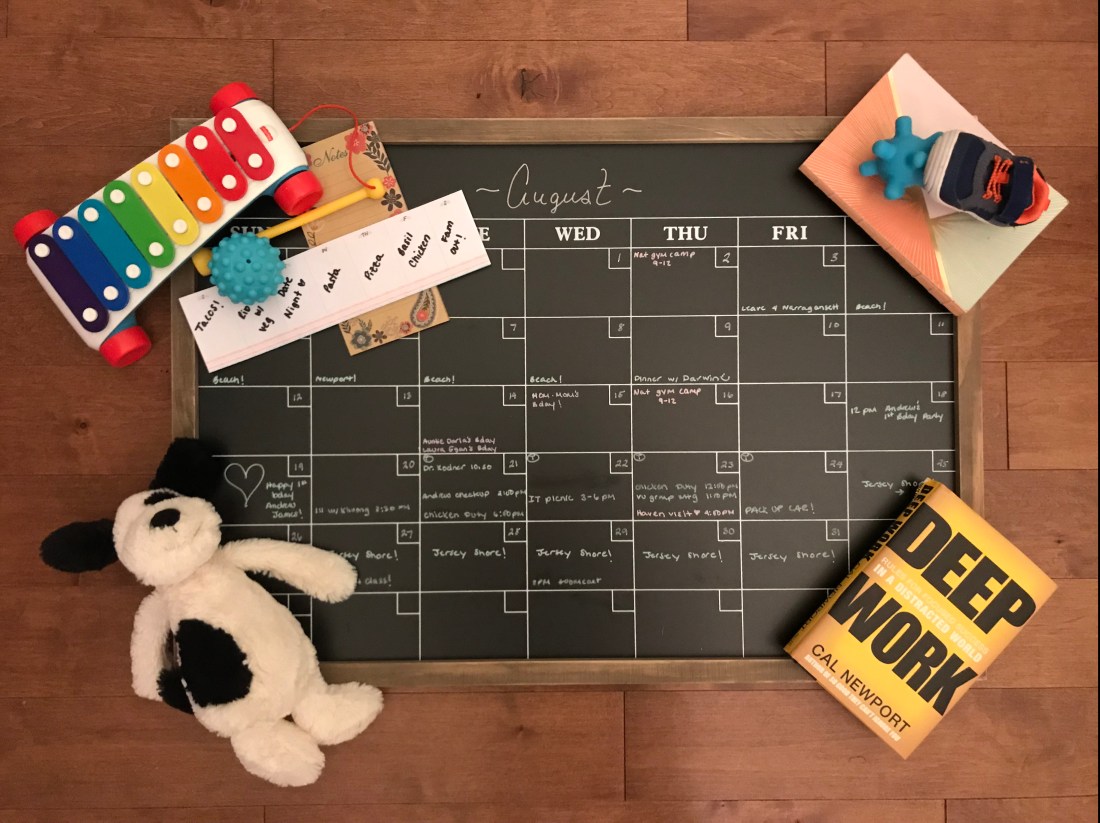
As a leader, I’ve been really affected by Newport’s book. I have done a lot of reflecting on how my own team is run and have identified many, many areas for improvement. While I am excited to take the leap into a more focused working style, I feel bad for the way the team has been run to date. I see the day to day chaos brought on by the pressure of keeping up with email overload, text threads, and incessant instant messages throughout the day and night. Even our personal time has been violated by the constant connectivity and the expectation that no matter what time of day, we are expected to answer the phone. We have gotten accustomed to working in a constant state of panic.

This week we had a major outage. The team including myself probably slept a cumulative 20 hours each between Monday and Friday. Then, at about 2AM on Friday morning, I was validating some critical payroll files and realized that someone on my team had made a HUGE mistake. A mistake brought on by sleep deprivation and workplace distraction, no doubt. I had to sacrifice my own sleep to review every single rate for every single person in the file, one by one. Looking back, if we had taken the time up front to properly plan, divide and assign the work instead of operating in sheer panic that thousands of union workers may not get paid correctly, maybe our success would have come a lot earlier than Saturday morning.

In an article from Talented Economy, “40 percent of an employee’s actual workday is spent on non-productive efforts, costing companies millions in lost productivity.” Furthermore, according to a statistic from Dynamic Signal, in a 40-hour workweek, the average worker spends 13 hours on email alone. I reference more eye-opening statistics in my recent white paper titled: Cultivating a Deep Workplace: How working deeply can take today’s project teams from scattered to streamlined.

The paper is meant to expose the day-to-day distractions project teams face as well as act as a guide for leaders, project team members and companies to alter their working style to optimize productivity and reduce workplace distraction. It is targeted at corporate project teams in hopes that it will help open their eyes to the inefficiencies of how we work today. I begin with a narrative describing the world of one worker, a data conversion lead on a global system implementation inundated by distraction day in and day out. I then reference Deep Work as well as many other articles to highlight major distractions within four main areas: Environmental, Operational, Habitual and Societal distractions. A lot of workers blame project leadership and their unreasonable deadlines for the day-to-day chaos, low-quality work and burnout among project teams. While I do believe this plays a factor, after reading Newport’s book, I think a whole lot more is within the team’s control than they think. “According to a survey conducted by Udemy Research — aptly named “2018 Workplace Distraction Report” — nearly 3 out of 4 workers (70 percent) say they feel distracted at work. As organizations place an ever-increasing focus on adopting new technologies to aid collaboration toward a more responsive, real-time business, we’re now on full-tilt communication overload.” Our global project team is made up of hundreds of team members. If more than half of them is spending their days without focus on their deliverables, it’s no wonder we aren’t meeting our deadlines and not surprising that we’ve had major quality issues among highly-skilled and intelligent workers. We expect our people to always be available and beyond that, we expect them to be working on OUR issue immediately even if they are currently working on a different task. This expectation not only leads to distraction, it also leads to workplace anxiety. We expect people to answer texts and emails immediately, and that is just violating! According to an article from The Atlantic titled How It Became Normal to Ignore Texts and Emails, a Tech Director at the Massachusetts Institute of Technology says “You create for people an environment where they feel as though they could be responded to instantaneously, and then people don’t do that. And that just has anxiety all over it,” These people need don’t need any more anxiety than they already have working on such a highly-visible project. I owe it to them to provide them with a workplace and project operating style that promotes concentration and productivity.

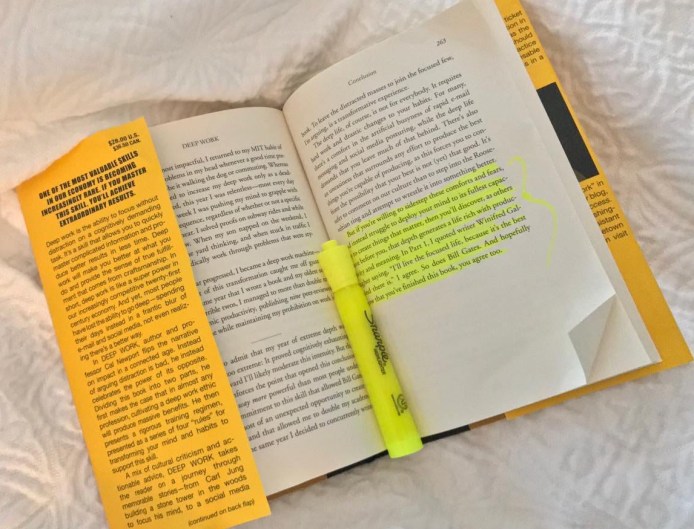
After reading Newport’s book, I feel both educated and empowered to employ an alternative work culture within my own team. And I already feel like the tides are changing – for the better. A new way of working is on the horizon in which my team’s performance, productivity and morale will become supported by leadership who values focus over chaos. From here on in, Cal Newport’s thoughts, ideas and principles will be my commandments. I am sure I will face adversity from those who haven’t yet become enlightened on the damaging effects on how we currently work. And you know what, they may just be getting an early Christmas present from me in the form of a tattered, marked-up, hand-me-down gold and black book.

Zero Gravity

IMG_3608

We all know that every object in space exerts a gravitational pull on every other – our Earth, the moon, you and I and so on. It holds together entire galaxies and keeps us physically grounded. Without it the human race would cease to exist, and with it we are able to inhabit and experience this beautiful Earth. An Earth that has striking landscapes, enchanting city skylines and more to see and do to last hundreds of thousands of lifetimes. As I type these words, I can’t help but reflect upon my own experience. How we experience the world today is so drastically different than it was just a few short years ago. I am not going to lie, I am feeling disturbed after reading an expose from the Washington Post whereby a former Facebook CEO divulges intimate secrets that tech companies like Facebook don’t want the public to know. From 2007 to 2011 Chamath Palihapitiya worked as the vice president for user growth at Facebook. In an interview with Amy Wang, he is open and candid about the work he carried out while at Facebook. “It literally is a point now where I think we have created tools that are ripping apart the social fabric of how society works. That is truly where we are,” he said. “The short-term, dopamine-driven feedback loops that we have created are destroying how society works: no civil discourse, no cooperation, misinformation, mistruth. And it’s not an American problem. This is not about Russian ads. This is a global problem.”

Yes, with the emergence of the smartphone, our experience has changed. More often than we want to admit, we choose to experience life through a five inch by three inch screen. We seem to have the world literally at our fingertips with apps that connect us with people across the globe and provide us with boundless information. However, something just doesn’t sit right. This weekend, while at our community’s annual Apple Harvest Festival, it wasn’t the extremely large, spinning thrill-ride appropriately named “Zero Gravity” that caught my attention with it’s flashing lights and spinning hunk of metal. Instead, it was what was going on inside the ride. One by one as the rotor spun, I watched the teen riders pass – more than half of them with their eyes glued to their smartphones. Side by side with their friends, experiencing the same thrilling ride together, yet living in a world of their own confined by their 3 inch by five inch screens. Some of them clearly “snapping”, others facetiming, and others who just seemed like they were scrolling through a newsfeed. As I watched, my husband turned to me and asked me why I looked so stressed. I quickly snapped out of my pensive moment, but I keep playing the scene over and over in my mind. I remember cool autumn nights with my friends as a teen riding thrill rides such as these together – holding hands, screaming and laughing with one another, feeling so connected with them through our experience. What could be more interesting in the 3 x 5 screen-world than the joy evoked from a shared experience among friends?? Were these kids bored even on a ride? Perhaps it’s the allure of the next big thing – the next up and coming thing that will appear at the top of their feed with its addictive “reverse chronological” design. According to Clive Thompson, “social media is designed to keep us trapped in the present and devoid of history.” We’re always focused on what’s next instead of spending a concerted amount of time focused around one thing. In his article titled, “Social media is keeping us stuck in the moment”, Thompson makes a valid point. “Some of society’s biggest problems, such as global warming, require careful long-term planning; we can’t tackle them if we’re being dragged in 20 directions every hour by shiny objects and oven-fresh hot takes.”

The kids on the ride remain at the forefront of my mind even days later. As I think about my own children and what I want for them out of this life, my mind wanders back to the striking landscapes and enchanting city skylines I imagined at the beginning of this post. I want them to see all of them and experience them with their own two eyes and own two feet. I want them to experience these things just to experience them, not for the disturbed reward-system of likes and comments on social media. I want raw and unbounded experience for them, confined only by all the possibilities they can imagine.

Oh, Hello, Trello…

TRELLOI’ve been doing some form of project management for over 10 years. I’ve taken project management training and certification courses, listened to podcasts, shadowed more senior project managers and read countless books on project management. Each project manager has his or her own style, and I’ve learned that there isn’t one right or wrong way to manage a project. However, there are some key principles that are required – one of those principles is understanding how to create a plan and deliver on schedule. Now, I have gotten really, really good at creating plans and sticking to them at work. I can drive teams to deliver products and services on time and under budget like I was born to do it. The one thing I can’t do, however, is stick to any kind of plan in my personal life. No matter what I try, it always falls to pieces. I can’t seem to get a consistent cadence going. The number one reason for this is because I lack focus in my personal life. I have so many obligations and things I need to do for my family, that I sacrifice most things for that. Part of the hardest thing about being a working mom is the constant desire to give your kids the life a stay-at-home-mom would be privileged enough to give them, only you’re also working 40-60 hours a week depending on the week. Driven by “working mom’s guilt”, our post-work trips to the park, board games, kitchen dance parties, manicures (with sparkles on top), and seasonal cookie decorating almost always trump whatever other tasks I put on my plate. This sabotages any plan I put together (for a good cause, of course…)
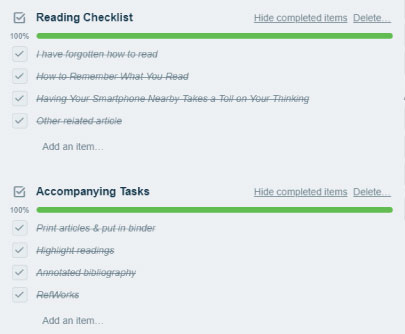
When I first signed up for Trello, I was hopeful that this project management tool could help me stick to a plan in my personal life, as well as offer a shiny new alternative to M.S. Project at work that would compliment our new Agile methodologies. Trello is comprised of boards, cards and other components like checklists. It lays out project work in a clear, hierarchical way that helps you break down the work into smaller, more manageable chunks. I love the simplicity and maneuverability of the cards. It took me mere seconds to build a framework and there wasn’t much of a learning curve (although I did watch a few video tutorials like How to Use Trello by YouTuber Jessica Stansbury). I started with a board for my Master’s ICM 502 class. I struggled a little bit in the beginning because when you start a new Trello project, you really have a very clean slate. You don’t really start with any kind of template at all. I found that I could think of many ways to slice and dice the work, which was a bit overwhelming. I finally decided to organize my coursework very close to the same way our internal university Blackboard site has it organized. It just made sense to me like this. I created a board for the course and then within that board, I have each week laid out with that week’s associated content, to-dos and assignments.

trello-2

I scheduled our weekly virtual meetings, so I make sure my husband and I can plan for him to be home from work before then to take care of our daughter. One feature I really loved was the ability to create checklists within each card. I am a list person, so this feature got me very excited. I was able to break down each learning module task into the components of the task that I personally carry out each week to complete my work. Having a visual diagram of my work is extremely helpful. It feels good to be able to check items off my checklists each week. My plan is to use this board that I created going forward in my coursework and then assess whether or not it helps get my school work done on time.

Another approach I am working on is using Trello to house my weekly schedule. I plan to have a list for my weekly routine and then a list for each day of the week where I can go into detail on the tasks related to that day. Stay tuned for more updates on my Trello Weekly Routine project!


We’ve Got Mail

8046010282_f5c5eeb282_b

Once again, Cal Newport hits the nail right on the head. Continuing my readings in Deep Work, Newport makes a statement in in Chapter 4: Work Deeply that resonated so deeply that I felt compelled to share his bold, but very true, statement with my own team.

“We instead find ourselves in distracting open offices where inboxes cannot be neglected and meetings are incessant – a setting where colleagues would rather you respond quickly to their latest e-mail than produce the best possible results.”

In one sentence, Newport sums up my experience working at my current company. We are email obsessed. Our teams sit together in an open concept “war room” setting. We expect that emails are answered within the same day that they were sent. We are distracted by pings from instant messenger all day long. We miss project deadlines and spend energy blaming unrealistic project due dates instead of working more efficiently in an environment that promotes focus and drives results. We hide behind our “shallow tasks” and allow our days to pass by moving emails from inboxes to folders.

I work on a very large-scale, corporate-wide, global system implementation. It is a highly complex project made up of hundreds of team members across the globe. The project began in 2014 and is scheduled to complete in 2020. Each of us is a mere cog in a very big wheel, and we are interdependent and directly influence each other’s work. Our deadlines are firm and aggressive. Our executive project sponsors are sharp and engaged. Each and every day the project team is sprinting towards the next task. Our teams are comprised of work-hungry, systems experts, project managers, developers and problem-solvers. This group of people is driven – with a proven track record of successful system go-lives in about 20 countries since 2014. Why, then, does this group of experts have such a hard time delivering completed tasks per the schedule, consistently and without having to work 16-hour days? Yes, I do believe one component is the aggressive timeline we are working against. However, if I pull back the covers on our daily operations, the thing that no one wants to own up to is the day-to-day lack of focus. No one wants to take the time to truly time block their days and remove all distraction from key blocks of time. The team prefers to immerse themselves in answering emails and sitting in meetings where they don’t add or gain value. Why? Because focused work is hard work and hard work is HARD. Email is time-consuming, but it’s not hard work. Anyone can do it. An article by Behavioral Scientist, Remedies for the Distracted Mind states, “Because of its ubiquity, email has proven to be a special case in aggravating a Distracted Mind. You may find it difficult to shut email down, but it is essential that you do so to remove the temptation to respond to the “ding” alert of an incoming message. As we now know, it can take you up to twenty or thirty minutes to return to your work once you allow an interruption.” On an aggressive project like the one I am on, there is no room in the day for multiple 30 minute distraction recoveries! Furthermore, according to an article on Semantic Scholar titled Checking Email Less Frequently Reduces Stress, “Email is among the most widespread online activities—in a 2011 survey, 92% of US adults reported using email to communicate (Pew Research Center, 2011). In addition to this ubiquity of email, people’s inboxes play a central role in their lives: More than one-third of US adults surveyed in 2014 said that email would be ‘very hard’ to give up—more than three times as many people who said the same about social media (Pew Research Center, 2014).” Too often, email replaces other, more appropriate channels of communication. The reason? Because it takes less brain power to fire off an email than to have a conversation with someone to work through a problem, ask a question, give feedback or make a comment.

Back to our team “war room”, besides email, our phones never leave our sides. Most times there are more smartphones on the table than there are laptops (everyone at the office has a personal AND work-issued smartphone) and there are DEFINITELY far less notebooks and pencils. If you look around the room in our meetings, every person is multitasking on their laptops and on average, in a one hour meeting, I’d say people check there phones a good 20 times.

It is clear, our brains gravitate towards the easy work. Because of this, we have developed into a culture that prefers to engage in the shallow work so we can go back and blame that shallow work as the culprit for not having enough time to complete the deeper, harder tasks. I think any one of us likes to think we could give up our distraction addition any day if we wanted to. However, I think most people, even my group of highly intelligent systems experts, would really truly struggle to keep their minds focused and challenge ourselves to really go deep. I think it’s time they give it a try, and I’m hopeful with the learnings from Newport’s book, that I will be able to guide their way.

The Experiment

plotted_data

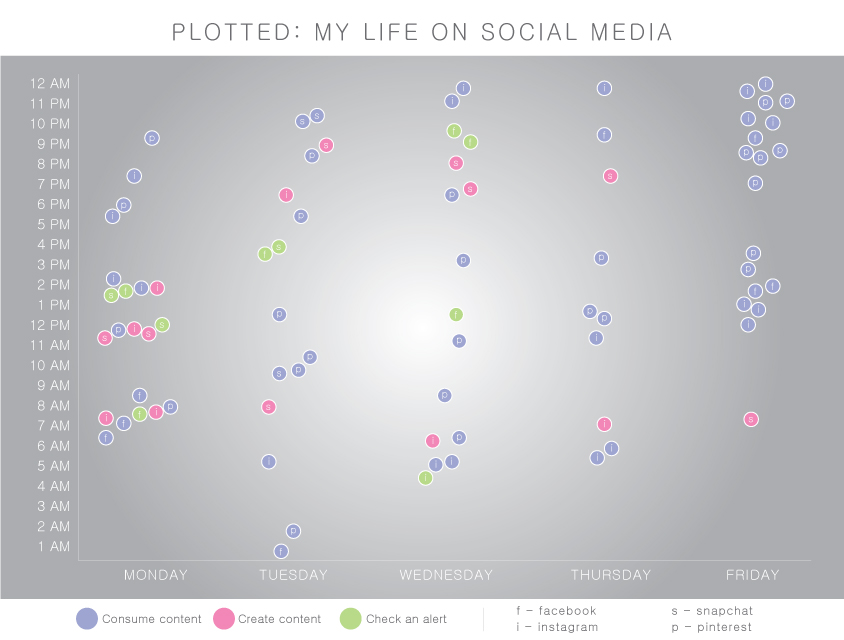
Wow. What a journey. This week has been eye opening to say the least. I gave up my social media favorites this past week: Facebook, Instagram, Pinterest and Snapchat. Then, I conducted a little personal data collection experiment: How many times throughout the day would I think about either consuming or creating content on social media and how many times would I go to check an alert? The results were astonishing, and I’ve been able to draw some significant conclusions from the exercise. Before I go into those conclusions, here is a little detail about how I conducted my data collection:

  • I moved my social media apps to the back of my phone.
  • Any time I thought about going on social media to post or consume content, I noted it with the time in my notepad on my phone. I later transcribed all occurrences into an Excel spreadsheet at the end of each day.
  • I captured which social media platform I wanted to use, the exact time of day, and whether I was going on to post, consume or check an alert.
  • I also captured some accompanying information not depicted in my final graphic (ex. what I was doing when I wanted to check social media and what exactly I wanted to do).
  • I then plotted each time in a graphic to illustrate my 5 day experiment in a meaningful graphic.
  • Midway through the week I turned off the alerts as I wanted to see if I stopped thinking about social media as much with the alerts turned off.
  • A larger, more readable version of my plotted data can be found here.

1) I have more time than I think I have.

I thought about social media 83 times this week, averaging ~17 times per day. Hypothetically, if I engaged in social media for just 4 minutes each of the 17 times, that totals to just over an hour a day. And let’s face it, there is no way my scrolling is limited to 4 minutes. This was pretty jarring. I complain more than anyone that there isn’t enough time in the day to get done what I need to get done and/or WANT to get done. However, I am wasting an hour of my day getting “Pinspo” on some project that I will probably never do or coveting the photo montage of my high school friend’s trip to Rome. Instead of wasting an hour a day on social media I could be actually working on that Pinterest-inspired project!! Yes, many of those 17 times were probably times where I was multitasking some other less pleasant activity (ex. unnecessary conference call or riding as a passenger in a car). My point being that I could not necessarily quantify the times I thought about social media and then in the future definitively seize that extra time to start that farmhouse dining room table project. Even if we cut the 17 number in half, representing potentially the number of times I engage in social media without multitasking some other activity, that still could be enough time for a nice 30 minute workout, yoga session, relaxing bubble bath or the “me time” I love to complain that I never get.

2) My brain has become very uncomfortable with r e s t.

I seize my phone and turn to social media at every chance I get. Whether it’s waiting at the dentist’s office or waiting for water to boil so I can throw in some pasta, I have my phone accessible and at the ready to save me from the silence of my own brain. What original, insightful, creative ideas am I missing out on by turning my brain “off” to the tune of a scrolling news feed? I am drowning in constant chatter and, while it seems like that would be exhausting and uncomfortable, I can’t shy away from it. According to a CNN.com article, Smartphone Addiction Could Be Changing Your Brain, “cell phone
addiction is on the rise, surveys show, and a new study released Thursday adds to a growing body of evidence that smartphone and internet addiction is harming our minds — literally.” The article expands to describe an experiment conducted at Korea University in Seoul that compared the brain scans of 19 “internet/smartphone addicted” teenage boys to 19 teenage boys who were not addicted and found physiological differences between the two groups, including “significantly higher levels of GABA, a neurotransmitter in the cortex that inhibits neurons, than levels of glutamate-glutamine, a neurotransmitter that energizes brain signals” in the group who was addicted. The article suggests that “medium to heavy multitaskers, who engage in multiple forms of media simultaneously, tend to demonstrate matter area in the anterior cingulate cortex, which is the area of the brain responsible for top-down attention control…Altogether this means that if you are too dependent on your smartphone, you are basically damaging your ability to be attentive.”

The scary part is that I can personally feel this happening to me…

3) I don’t live in the present moment.

The world of social media is made up of the “haves” and “have-nots”. It’s very easy to become consumed with the latter and throw your own life into that bucket. The sheer nature of “following” someone on social media, opens yourself up for judging the quality of your own life. Your life becomes altered and soured by the constant nagging reminder that *someone* else’s life is better than yours. Someone else’s kids are sleeping through the night. Someone else has #postpartumrockhardabs. Someone else’s career is moving at a faster pace than yours. You begin to live vicariously through that person or that account and instead of enjoying the moments of your own life in the moment. According to an article by The Atlantic titled, Have  Smartphones Destroyed a Generation?, The “rates of teen depression and suicide have skyrocketed since 2011. It’s not an exaggeration to describe iGen as being on the brink of the worst mental-health crisis in decades. Much of this deterioration can be traced to their phones.” The iGen population the article is referring to describes the population of “kids” born between 1995 and 2012.

While conducting my data collection exercise, I read chapter 3 of Cal Newport’s Deep Work titled “Deep Work is Meaningful”. This chapter is the one that has resonated with me the most thus far. He opens the chapter discussing the life’s work of a present-day blacksmith who practices an art of ancient and medieval metalwork. He paint’s a picture of this blacksmith, named Ric Furrer, isolated in his converted barn in Wisconsin farm country. He discusses how precisely Furrer carries out his process and how he handles each piece of art with extraordinary care. The point he is trying to make that the work of a craftsman is meaningful  and the execution of that craftsmanship is almost always in deep concentration, attention and focus. Later in the chapter he theorizes that there is a connection between deep work and work that has great meaning. Shallow work, like engaging with social media or answering emails does not allow our human brains to enter a state of any kind of concentration. We are bombarded with attention-grabbing one-liners, video clips and hashtags, and our brains are completely unfocused. IT DOESN’T FEEL GOOD. It is shallow, meaningless work and I couldn’t agree more with Newport’s statements. He goes on to say, “Human beings, it seems, are at their best when immersed deeply in something challenging.” I love this quote. Social media is entertaining, but after scrolling for 20 – 30 minutes, I can honestly say that I don’t feel accomplished or satisfied. However, give me some old wood pallets, 2x4s, a drill and wood glue and ask me to build a tikki bar (true story), and I am on cloud 9.

So what am I going to do with the conclusions drawn from my exercise? I can tell you one thing, the social media apps are staying at the back of my phone, out of immediate sight. At this point, I don’t think I will ever do completely away with them, especially as a parent who will want to monitor the social media accounts of my kids. The exercise has really gotten me to think about my time and how I want to spend it. I can’t tell you how much highlighter and marginalia appear in Chapter 3 of Cal Newport’s Deep Work book. It really took me back to thinking about my childhood and how I spent my time. Woodworking, crafting, thinking, creating – all of the above occupied my time and I was a truly happy kid with a genuine love for hard work. I want to feel more of this and cultivate time in my schedule to work with my hands more. On the flip side and equally as important, I want to treat my career in Digital Technology as my master craft. I want those on my team to elevate themselves from the daily shallow work world of email and engage in meaningful activities and problem-solving. Newport believes that we can apply the same principles that apply to the world of craftsmen to the world of knowledge work. After reading Chapter 3, I am already a believer.

Still the Hare…

multitask

As a kid, do you ever remember getting challenged to rub your belly at the same time you were patting your head? You’d undoubtedly end up patting your belly and rubbing your head or some very awkward combination of both. How about trying to do homework in front of the television while eating your after school snack? I can certainly remember my homework being much more enjoyable if I was watching “Boy Meets World”, but I also remember it taking twice as long to complete it. As a notoriously huge fan of multitasking, I have been coming to the harsh and disappointing realization that less is definitely more when conducting multiple tasks at the same time.


Multitasking creates an illusion of productivity. The myth of its efficiencies dates way back. Even Philip Stanhope, 4th Earl of Chesterfield in one of the letters to his sons advised, “There is time enough for everything in the course of the day, if you do but one thing at once, but there is not time enough in the year, if you will do two things at a time.” I found this quote while reading an article from The New Atlantis aptly titled “The Myth of Multitasking“. Moreover, in an article from Forbes.com, researchers from the University of Sussex in the UK discovered long term effects on the human brain from constant multitasking. The research “…compared the amount of time people spend on multiple devices (such as texting while watching TV) to MRI scans of their brains. They found that high multitaskers had less brain density in the anterior cingulate cortex, a region responsible for empathy as well as cognitive and emotional control,”https://www.forbes.com/sites/travisbradberry/2014/10/08/multitasking-damages-your-brain-and-career-new-studies-suggest/#73bf2b0a56ee“.


So, if we know it’s inefficient and it’s hurting us, then why do we do it? Why does it feel so good to write this blog post, while answering texts from work, explaining to my husband how to prepare dinner and ironing clothes for the week in between? According to Cal Newport, it’s wrong…but, personally, it makes me feel like a powerful and productive #SuperMom. On the other hand, I make mistakes. I make constant mistakes. The iron was set way too high. I forgot to tell my husband to use the sharp cheddar instead of the mozzarella. I have to go back and read the text thread from my developer because I may have misunderstood his initial question and answered pre-maturely. This blog post is rambling instead of GETTING TO THE POINT [insert awkward smile emoji]. The point I’m trying to make is that I know my quality suffers when I do too many things at once, and I can clearly apply this to numerous facets of my life. I swim in my own self-limiting belief that I don’t have enough time in the day to complete all of my tasks, so I try to squeeze as many tasks as possible into short bursts of time thereby decreasing the quality of my output. Newport’s teachings in his book Deep Work have certainly opened my eyes to the inefficiencies of my current operational state, however, I have not yet determined a strategy for corrective action. In his book, he illustrates a formula for the “law of productivity.” It can be defined as “High Quality Work Produced = (Time Spent) x (Intensity of Focus). My personal goal is to figure out how I can increase the (Time Spent) portion, and that seems to be quite difficult with 2 small children, a highly demanding job and household to run. However, I know there are others with equally busy lives who are excelling.


This may be the “Mommy” in me, but I can’t help but think of the strategy behind the tortoise’s success in Aesop’s Fable The Hare and the Tortoise. Slow but steady wins the race. The steady portion is the key.


Deliberate. Consistent. Focused.


I’ve made it my personal mission to become a tortoise in a world of frantic, unproductive, distracted hares. At this point, however, I still very much identify with the latter…

Confessions of a Distracted #BossMom

img_2762-1.jpg2:52 AM: I am just sneaking back into bed after getting my 12 month old son back down to sleep. I have to get a good night’s sleep or I am not going to wake up in time to create my slides for the 9:00 AM meeting.

3:06 AM: Still awake. I reach for my phone conveniently placed on my bedside table and check some emails (Offshore team in Bangalore is just finishing up some data collection activities and I should check in with them anyway).

3:28 AM: Crap. I just realized I never ordered the floral arrangements and modern farmhouse wood sign’s for my cousin’s engagement party! I PROMISED I would do this. No problem…I will just peruse Pinterest for some inspo.

3:30 AM: Pinterest has some really great ideas for mudroom organization! Ugh…not in the budget.

3:32 AM: DIY mudrooms!!! This is great. I am sure we could do this ourselves! Look…this Pin says it will only cost $12.53 for all materials to build “The Mudroom of a Busy Working Mom’s Dreams.”

3:33 AM: Speaking of “Busy Working Moms”, I loved that “How to Be a #BossMom” video my girlfriend shared. Such an inspiration! I am totally a #SuperMom who #hasitall with two #beautifulkids and climbing the #corportateladder with #effortlessease. I can meal plan. Project plan. Monthly plan. Timeblock. Build blocks. Task manage. Task List. Shopping List. Weekly routine.  Plan weekly routines for scheduled tasks on the monthly plan. All. Day. Long. YEAH!!

3:35 AM: Baby is up AGAIN. Why? WHY!?!? Is there something wrong with him? He should be sleeping through the night by now.

3:36 AM: “8 Signs Your Child Is On A Path to Self Destruction At An Early Age”. OMG.

3:48 AM: “25 Things Every Child of Working Parents Needs To Feel Special”.

3:50 AM: “How Too Much Structure Is Stifling Our Kids’ Creativity”.

3:51 AM: “Why Kids Need To Spend More Time Outside In Nature”.

3:52 AM: “12 Reasons Your Kid Isn’t Sleeping and Why It’s Probably Your Fault”.

3:53 AM: I should quit my job. I need to stay home with my kids. We need to downsize. Maybe we should move? To an island. We could homeschool! We should probably become vegan too. The kids eat too much sugar.

4:08 AM: “SUGAR. The Silent Killer.”

4:10 AM: OMG.

4:12 AM: We need to detox. As a family. “10 Ways You Can Model Healthy Behavior to Set Your Child Up for Success In Life.” Ugh. We *loosely* do 4 out of 10.

4:45 AM: Ping. Offshore team is pinging me. I can hear my laptop in the other room. Ugh.

4:48 AM: This girl I follow on Insta is so fit. How did she pop out 2 kids? Look at her cute little vegan kids “Eating The Rainbow”.

5:02 AM: I need to workout. My baby is 12 months old now and I have no excuse not to be back to my pre-pregnancy weight with my pre-pregnancy abs. I should be in a routine by now, but the only time I could work out is when the kids are sleeping. By the time they go to bed, I’m too tired. “The Healthiest People Workout in the Morning”. Ugh…I could never do that. I’m too tired in the morning. If only I could get a good night’s sleep!!

5:04 AM: Ok…I need to get some sleep so I can wake up and workout.

6:06 AM: *Footsteps from down the hall*…”Mommy. Mommy. MOM, ARE YOU AWAKE??”.

Hi. I’m Angela. This is an excerpt from my life. Most days I like to think I have got my stuff together. At a macro-level, my kids are happy and healthy. I have a lucrative job and a forward-moving career. I am a supportive and loving wife. I have a beautiful home and a close-knit family. I must confess, however, that I live a very distracted life. I am distracted by technology, by my to-do lists, by my over-commitments, by the people who inspire me, by others who discourage me, by the many things I want to do in life and that I fear I won’t get to do because time is finite. My distraction leads to unfinished projects, wasted time, crying kids who need their mom’s focused attention, disorganized work weeks and a very unhappy, not to mention anxious ME. The worst part of all of this…is that I am addicted to my distraction. Doing one thing at a time is almost painful. My brain has been wired for such a long time to do more than one thing at a time.

This is why I have decided to begin a journey of self-improvement. I want to become a more focused individual. I want to quiet my brain to help me problem solve better and more proactively. I want to know how to create more focused time doing the things I love instead of allowing articles, pins and videos cause me unnecessary anxiety. I want to fuel my creativity with my own brain cells instead of needing inspiration from others I follow on social media. I still want to #haveitall, even if that means the number of things on my plate reduces to only the few most important.  I want to find inner peace. Some days I feel like my brain is a classroom of young children all screaming at once for their teacher to call on them. I get overwhelmed easily because my brain is getting pulled in so many different directions. I want to work smarter. I want to BE smarter. I want to find time to truly rest without being tempted by the little squares on my iPhone. I want to act on my dreams instead of constantly wishing I had the time to pursue them. Most of all, I want to model a focused lifestyle for my children – one with meaning and thoughtfulness vs. a continuous task-driven frenzy.

During this journey, I have three goals. My first goal is to maximize productivity by reducing the noise of my highly distracted lifestyle. My second goal is to quiet my mind through the practice of deep thinking and meditation. My third goal is more pragmatic – to implement a lifestyle system where I create scheduled time each day for “deep work” and meditation. For those of you fellow multitaskers out there, I don’t want you to think that I plan to discourage *all* multitasking. I do believe that there are certain tasks and times of day when multitasking can boost productivity. However, I do believe that most of us get to a point of diminishing returns. This is where my most recent read “Deep Work”, by Cal Newport has come into play. I’ve picked up the book for my second graduate degree and couldn’t be more engrossed in its teachings, and I am only one chapter in.

“Deep Work”, as defined by the author, is the ability to focus without distraction on a cognitively demanding task. Newton says his concept of “Deep Work” allows individuals to “quickly master complicated information and produce better results in less time”. It is counter-intuitive to my typical day-to-day game of “cram as many tasks into a single block of time as possible”. I am completely inspired by the notion that there may be a better, more efficient way to live and work. I am also fascinated by the idea that I could actually become smarter by focusing my time and energy on one thing at a time and free from all distraction. The practicality of the book for someone like me, a thirty-something mother of two small children with a high pressure corporate job leaves me feeling skeptical that I could actually employ the teachings. I mean, as I type this post, we have just walked in the door from a beach vacation with two cranky kids who just spent 4.5 hours in the car and don’t want to go to bed. The baby is crying because he wants me to hold him and my pre-schooler is yelling for my attention, while my laundry room is bursting with chores. And then there is always Amazon Prime, Pinterest, Instagram, Facebook, SnapChat, and email that call to me with their enticing “shallow work” tasks. Still, I am going to give it a shot. I hope you enjoy the ride and I am so looking forward to your comments and contributions!

– Angela